

Skip to content
VerifiX — secured by ITSEC

Platform · KYT

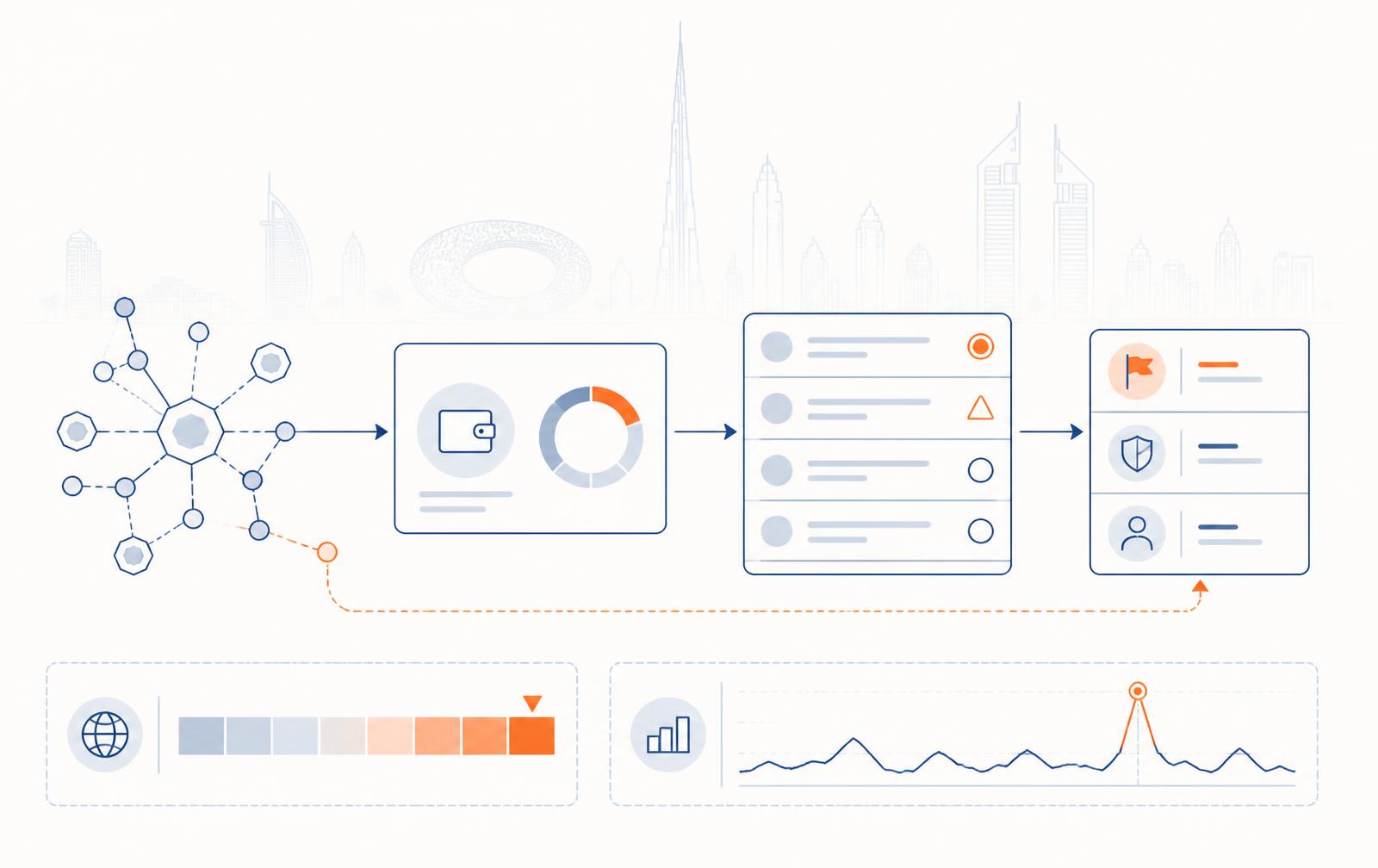
Watch the money move, on-chain and off.

Wallet risk scoring, counterparty attribution, exposure tracing, and rule-based transaction monitoring that ties a blockchain transfer back to the verified customer who made it.

POST /v1/transactions/screen
curl -X POST https://api.verifix.ae/v1/transactions/screen \
  -H "Authorization: Bearer $VERIFIX_KEY" \
  -d '{
    "customer_id": "cus_2LX...",
    "direction": "inbound",
    "asset": "BTC",
    "amount": "1.482",
    "counterparty_address": "bc1q...7f4a"
  }'

{
  "decision": "escalate",
  "wallet_risk": 78,
  "exposure": [
    { "category": "sanctioned_entity", "hops": 2, "share": 0.11 },
    { "category": "mixer", "hops": 1, "share": 0.34 }
  ],
  "triggered_rules": ["mixer_exposure_gt_25pct"]
}

What it checks

Every check, named

No bundled black box. Each check is listed, configurable, and visible in the decision it produced.

Wallet risk scoring

Inbound and outbound addresses scored on attribution and exposure. Supported chains and assets: the major public chains and their tokens are covered.

Counterparty attribution

Addresses attributed to exchanges, mixers, darknet markets, ransomware, gambling, and sanctioned entities where attribution data exists.

Exposure tracing

Indirect exposure traced across hops with the share of value from each risk category, so a two-hop mixer path is not invisible.

Fiat transaction monitoring

Thresholds, velocity, structuring, and geography rules across fiat rails, using the same rule engine as the on-chain side.

Travel rule support

Originator and beneficiary data handling for transfers above the applicable threshold — the AED 3,500 threshold, with Notabene and TRP messaging.

Customer-linked alerts

Every alert is attached to the verified customer and their KYC evidence, so a monitoring hit opens with full context.

How it runs

From request to decision

The same sequence whether you call the API directly or use the hosted flow.

  1. 1

    Register the customer

    Transactions are submitted against a customer ID that already carries a verified identity and risk profile.

  2. 2

    Screen the transfer

    Counterparty attribution, exposure tracing, and your monitoring rules evaluate before you release funds.

  3. 3

    Alert and investigate

    Escalations land in the case queue with the exposure breakdown, transaction graph, and the customer's history.

  4. 4

    Report

    Investigation outcomes export into internal SAR/STR workflows — reports are exported per case and per period for your regulator.

Transaction trace · 0x9f…c204Sample data
  1. 1Customer walletVerified · low
  2. 2Exchange depositLicensed VASP
  3. 3Intermediary2 hops · medium
  4. 4Mixer-linked clusterHigh risk

Exposure

Indirect

Hops

3

Action

Alert raised

Modules

The checks behind this pillar

Each one is a separate module you can switch on, order, threshold, or skip inside a journey.

Transactions and wallets

8 modules

Post-onboarding risk: rule-based transaction monitoring, on-chain wallet exposure, and Travel Rule counterparty data.

Transaction monitoring

transaction_monitoring

Runs your rule set over each transaction in real time or in batch: velocity, structuring, threshold avoidance, unusual corridors, dormancy reactivation, peer-group deviation.

Input
Transaction event, or a batch file
Returns
risk score, triggered rules, alert case where thresholds are breached

Wallet screening (KYT)

wallet_screening

Scores a crypto address before you pay out or credit a deposit: sanctioned address exposure, darknet, mixer, scam, and high-risk exchange exposure, direct and indirect.

Input
Address and chain
Returns
risk score, exposure categories with hop distance, recommended action

Source and destination tracing

transaction_tracing

Traces funds back through hops to the originating cluster and forward to the destination, giving the analyst the picture rather than a lone score.

Input
Transaction hash or address
Returns
hop graph with cluster attribution and exposure per hop

Travel Rule messaging

travel_rule

Exchanges originator and beneficiary information with counterparty institutions on qualifying transfers, and records what was sent, received, or refused.

Input
Transfer details and counterparty VASP
Returns
message record, counterparty response, unhosted-wallet declaration where applicable

Counterparty VASP discovery

counterparty_vasp_discovery

Attributes a destination address to an institution and resolves whether a Travel Rule message can be delivered to it, or whether the destination is an unhosted wallet.

Input
Destination address and chain
Returns
counterparty type, resolved institution, reachable protocol, sunrise flag

Travel Rule scope test

travel_rule_scope

Decides whether a transfer is in scope before any personal data leaves your tenant, using the threshold and transfer rules of the applicable regime.

Input
Transfer amount, asset, direction, jurisdiction
Returns
in_scope flag with the threshold and rule version applied

Unhosted wallet ownership proof

unhosted_wallet_proof

Collects proof that a self-custody destination belongs to your customer: signed message, declaration, or in-session verification, retained as an artefact.

Input
Address, customer ID, chosen proof method
Returns
proof artefact, method used, verification result

Ongoing wallet monitoring

ongoing_wallet_monitoring

Watches previously cleared addresses and raises an alert when a wallet becomes sanctioned or gains exposure after you approved it.

Input
Address list under monitoring
Returns
change alerts with the new exposure category and the affected customers

See the full module catalog — every KYC, KYB, AML, KYT, and platform module with its inputs and outputs.

Evidence retained

What your auditor sees

  • Transaction payload as submitted, with timestamp
  • Wallet score, attribution labels, and data source version
  • Exposure path per risk category and hop count
  • Rules evaluated, triggered, and their versions
  • Investigator notes, outcome, and any report reference
Decision
allow · review · escalate · block
Wallet risk
0–100 with category breakdown
Monitoring
real-time on submission, plus retrospective sweeps
Delivery
API response + webhook + console alert

Questions

Frequently asked

Do you monitor after the transaction is approved?
Yes. Retrospective sweeps re-evaluate historical transfers when attribution data changes, and raise alerts on customers you already cleared.
Which chains are covered?
The major public chains and their tokens are supported, with new chains added on request.
Can we write our own rules?
Yes — the rule builder is shared with the risk engine, so monitoring rules and onboarding rules live in one place.

See VerifiX on your own onboarding flow

A 30-minute walkthrough with a compliance engineer, or a sandbox key in your inbox today.